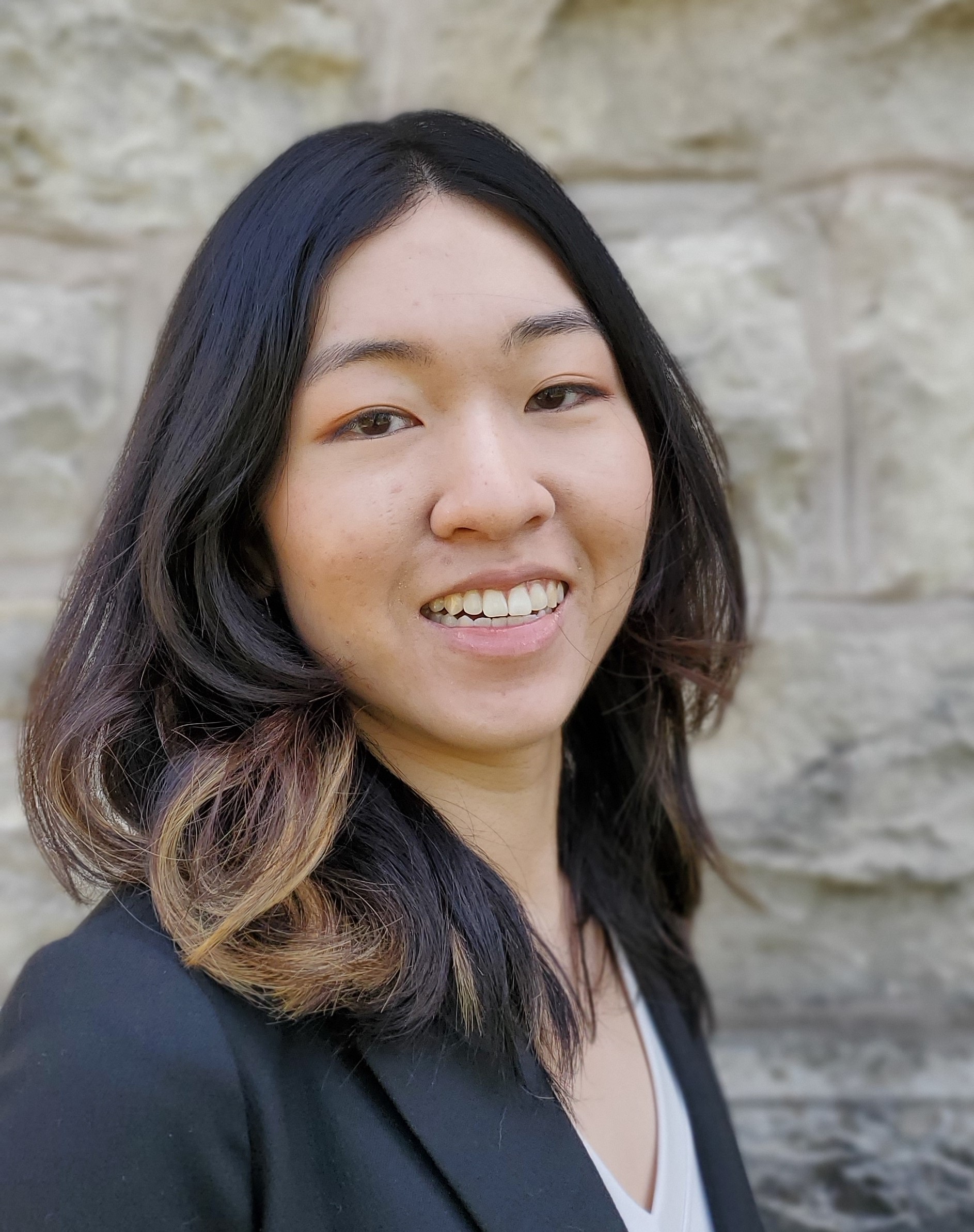
Caroline Wang
I am a Research Scientist on the multi-agent learning team at Google DeepMind. I completed my Computer Science Ph.D. at UT Austin, supervised by Peter Stone. During my Ph.D., I was fortunate to intern at Google DeepMind, where I was hosted by Pablo S. Castro, and at Sony AI, where I was hosted by Varun Kompella.
I’m currently motivated by a vision of AI agents that can work alongside humans—contributing to and benefiting from the collective knowledge and effort that drives human progress, unlocking new forms of collaboration that neither humans nor AI could achieve alone, and ensuring that such collaboration is steered by shared values.
My PhD work pursued the above vision through the lens of multi-agent reinforcement learning: understanding cooperative dynamics in multi-agent settings, and designing algorithms to enable agents to coordinate with previously unseen teammates towards shared goals (ad hoc teamwork). More broadly, I’m interested in the principles of learning necessary for cooperation, generalization, and emergent abilities in rich multi-agent systems, including continual learning and agents learning from other agents.
I received a B.S. in Mathematics and Computer Science from Duke University, where I researched interpretable machine learning methods for criminal recidivism prediction with Cynthia Rudin, including an analysis of the COMPAS algorithm that offered an alternative explanation for its previously observed racial bias. My work was recognized with a Goldwater Scholarship, a premier undergraduate research award in the United States.
Timeline
2026
Joined Google DeepMind as a Research Scientist
Started as a Research Scientist on the multi-agent learning team, and relocated to London.
Completed my PhD at UT Austin
Defended my dissertation, Agents Learning With and From Other Agents, advised by Peter Stone.
ROTATE: Regret-driven Open-ended Training for Ad Hoc Teamwork
ROTATE accepted to NeurIPS as a spotlight. Instead of training against a fixed population of teammates, we alternate between improving the ad hoc teamwork agent and generating new teammates that probe its weaknesses.
Spotlight (top 2%) at NeurIPS 2026; oral spotlight at CoCoMARL 2025
Discovering Differences in Strategic Behavior Between Humans and LLMs
Presented this work at ICML. We used AlphaEvolve to discover interpretable models of behavior directly from data, and found that frontier LLMs can play more strategically than humans in iterated rock-paper-scissors. This came out of my time at Google DeepMind.
Co-organized the MAL-GAI workshop at ICLR 2026
Served on the organizing committee for the Workshop on Multi-Agent Learning and Its Opportunities in the Era of Generative AI, which ran at ICLR in Rio de Janeiro.
JaxAHT: A JAX-Based Library for Ad Hoc Teamwork
Led a team of nine in releasing JaxAHT, the first open-source JAX library for ad hoc teamwork. It gives a unified pipeline for teammate generation, training, and evaluation, with substantial speedups over PyTorch implementations. Presented at the MAL-GAI workshop.
2025
ROTATE at the Google DeepMind RL reading group
Presented ROTATE and the open-ended training approach behind it to the reinforcement learning reading group at Google DeepMind.
Student researcher at Google DeepMind
Joined Google DeepMind through February 2026, hosted by Pablo Samuel Castro. I worked on using LLM-powered program discovery to study how humans and LLMs behave in strategic scenarios.
2024
N-Agent Ad Hoc Teamwork
Presented N-Agent Ad Hoc Teamwork at NeurIPS. Existing work assumes either that every agent is controlled or that only one is, so we formalized the setting in between and proposed an algorithm for it.
Co-organized the ALA workshop at AAMAS 2024
Served on the organizing committee for the Adaptive Learning Agents workshop for a second year, this time at AAMAS in Auckland.
Building Minimal and Reusable Causal State Abstractions for Reinforcement Learning
Presented CBM at AAAI, joint first-authored with Zizhao Wang. The method learns the causal relationships in the dynamics and reward for each task, and keeps only the state variables that task actually needs.
2023
Research intern at Sony AI
Summer internship hosted by Varun Kompella, developing experience replay methods to improve reinforcement learning sample efficiency on Sony's game environments.
D-Shape: Demonstration Shaped Reinforcement Learning
Presented D-Shape at AAMAS. It resolves the conflict between imitating suboptimal demonstrations and maximizing task reward by treating the demonstrations as shaping rewards, so the agent can still converge to the optimal policy.
Co-organized the ALA workshop at AAMAS 2023
Served on the organizing committee for the Adaptive Learning Agents workshop, held at AAMAS in London.
DM² at the Multi-agent RL reading group
Presented DM² and its approach to coordination without explicit communication to the UMD Multi-agent Reinforcement Learning Reading Group.
DM² at the Cooperative AI Lab
Invited talk to Prof. Yali Du's lab on distributed multi-agent reinforcement learning via distribution matching.
DM$^2$: Distributed multi-agent reinforcement learning via distribution matching
Presented DM² at AAAI. We showed that independent agents can learn to coordinate without explicit communication, as long as each one matches a target distribution of trajectories from a joint expert.
2022
In pursuit of interpretable, fair and accurate machine learning for criminal recidivism prediction
Published in the Journal of Quantitative Criminology. We compared interpretable recidivism models against two deployed risk assessments, COMPAS and the Arnold PSA, and found that simple, readable models can match or beat them.
2020
Started my PhD at UT Austin
Joined Peter Stone's group at UT Austin.
Graduated from Duke University
Graduated with a B.S. in Computer Science and Mathematics, with highest distinction.
The age of secrecy and unfairness in recidivism prediction
Published in Harvard Data Science Review. By partially reconstructing COMPAS, we showed that it does not depend linearly on age as its creator described, and that its previously reported racial bias can be explained by age and criminal history.